Practical guide for investors and family operators of entertainment centers.
TL;DR
- The playroom without screens does not fight the technology of the number of stimuli, but offers real movement, relationships and a sense of perpetuity.
- Children remember the experiences: the defeated challenge, the shared mission and discovery, not the device specification.
- Different routes, events and thematic scenarios make the space not ending after the first visit.
- If technology comes in, it should react to the body and support activity instead of keeping the child from the monitor.
The key decisions in a nutshell
| Need for a child | That gives you space | Example |
|---|---|---|
| Move | Full involvement of the body | Climbing, balance, jump and chase |
| Perpetualness | Visible Progress | Harder route or own record |
| Relations | Face-to-face cooperation | Team mission and common rules |
| Imaginations | An Open History | Jungle, cosmos, castle or expedition |
Action Plan
- Design activities that require a whole body, not just hand reactions.
- Add challenges with several roads and increasing levels of difficulty.
- Create opportunities for cooperation, mutual discovery and family fun.
- Regularly change scenarios, tasks or small elements of experience.
Even a few years ago, children spent most of their free time in the backyards. They ran, climbed trees, built bases, and learned the world through movement. Today, this image looks completely different. More and more of the day is occupied by smartphones, tablets and consoles, and the digital world has become a natural environment of growing up.
Technology is not a problem in itself. The problem arises when it begins to replace what is most important for the proper development of the child – physical activity, contact with peers, developing imagination and spontaneous fun. This is why the role of the modern Family Entertainment Center is becoming bigger today than ever before.
A well designed entertainment centre does not compete exclusively with other playrooms. Every day it competes with a phone screen that is available to the child anytime and everywhere. To win this competition, it is not enough to put a larger structure or add another slide. You need emotions that the digital world can’t replace.
Children don’t remember devices. They remember the experiences.
Investors often start the project with a selection of attractions. They analyze the height of the structure, the number of slides, trampolines or interactive devices. These are important decisions, but from the perspective of the child they look completely different.
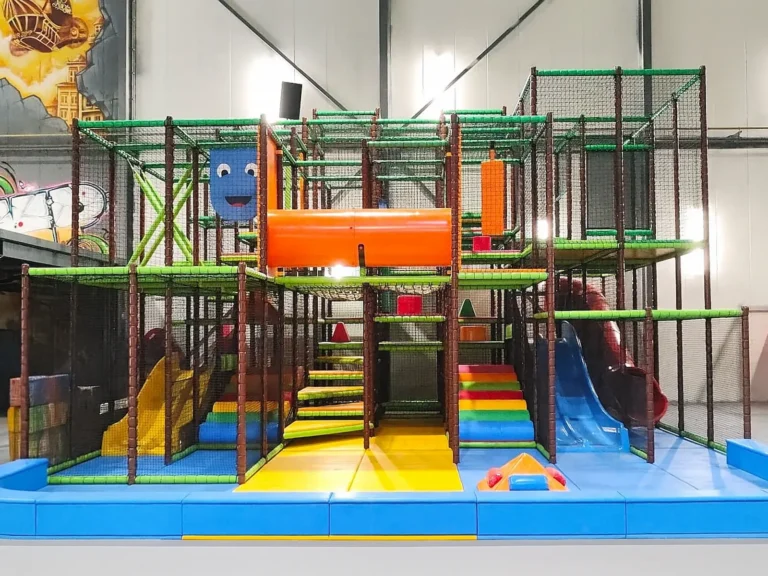
For a child, the construction is not a steel frame with platforms and nets. It’s a pirate ship, a mysterious jungle, a castle full of secrets, or a space base. It’s imagination that gives space real meaning.
The strongest memories do not arise when using a particular attraction. They are born when the child dares to enter the highest level of construction, overcome the difficult obstacle course, or together with his newly-known colleagues discover a mysterious passage leading to the next part of the playground.
It’s the emotions that build memories. And memories make the kids want to come back.
The biggest competitor is not another playroom
Even a few years ago, investors compared their projects with local competition. Today, the situation is completely different.
Family Entertainment Center’s biggest rival is not an object located a few kilometres away. It is a phone screen that does not require access, no opening hours and every day provides new stimuli to the child.
If the entertainment center is to compete effectively with the digital world, it must offer something that cannot be found on the Internet.
Real laughs.
Real move.
Real emotions.
Real relationships.
No computer game will replace the satisfaction of defeating its own fear, a common race with siblings or the joy of discovering another nook of construction. It’s a experience that stays with the baby much longer than the next video watched on the screen.
The best playgrounds develop children, even if they do not notice it
The most valuable learning often takes place during simple fun.
Climbing develops motion coordination, balance and strength. Overcoming obstacles teaches patience and endurance. Playing with other children develops communication, cooperation and conflict resolution skills.
The child does not think that he is just practicing his concentration or building confidence. It’s just having fun.
It’s a great value for parents, too. They are increasingly looking for places that will not only provide entertainment but will also support the development of their children. Family Entertainment Center is thus becoming a space that combines fun with activity and science, without taking away children’s joy from discovering the world.
Kids get bored fast. That’s why space has to live.
One of the biggest mistakes when designing playrooms is the belief that it is enough to create a large structure for children to visit it for many years.
Reality is different.
Children love to explore new places and look for more challenges. When they see exactly the same thing on each visit, the level of excitement gradually decreases.
The modern Family Entertainment Center should constantly stimulate curiosity. Different routes, hidden passages, interactive elements, seasonal events or thematic animations make even well-known space possible to offer new experiences each time.
It is a surprise element that builds engagement and encourages children to visit again.
The success of the investment starts with understanding the child
The most profitable Family Entertainment Center are not always the largest or the most expensive. They’re connected by something else.
They are made with children in mind, not devices.
Each element of space is to stimulate imagination, encourage movement and create emotions. The child can’t see the construction from pipes, grids and platforms. He sees a place where he can experience adventure, test his abilities and create his own history.
That’s why he’s coming back.
And when the baby wants to come back, the parents come back.
From the investor’s perspective, this is one of the most important dependencies in the whole business. Advertising may encourage the family to visit first, but only positive experiences of the child will make subsequent visits a natural choice.
The well-designed Family Entertainment Center does not win with more triggers. It wins by offering something technology will never replace – movement, discovery, shared experience and emotions that remain in memory for long years.
Related Indoor Play Concept resources
Do you have a project or a working object? Get a consult with the Indoor Play Concept.